


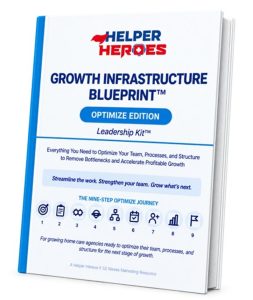

The Growth Infrastructure Blueprint™

Three editions, one for each revenue stage. Pick yours, work its nine steps with your office team, and finish with a written 90-day plan for what to fix, hand off, and measure.

60

pages, no cost

9

steps per edition

19

years in home care


Which model describes your business?

Select your annual revenue band.

That is your edition, and the nine steps below change to match it.

Build

$0 to $2M

You and a small office team carry nearly everything. Growth speeds up and stalls depending on how busy the week is.

Optimize

$2M to $12M

You have a team but too many tasks that keep them from doing the important work you hired them to do. Your calendar is still reactive, and most decisions still route through you.

Scale

$12M and up

Multiple locations or a regional footprint. You need capacity, a scorecard, and leaders who run their own numbers.

Not sure? Pick the band just below where you are. The steps build on each other.

Growth gets harder when the infrastructure behind it can’t keep up.

More clients. More caregivers. More referrals. More moving parts.

At some point, growth starts putting pressure on the way work gets done. Priorities compete. Important work gets pushed aside. Key responsibilities stay with the wrong people, or live only in someone’s head.

The infrastructure that got you here may not be the infrastructure that gets you where you want to go next.

Growth exposes what your infrastructure can’t support.

Work that only lives in the owner's head disappears the week the owner gets pulled into operations.

Tap

What You Do About It
Step 3 sets a minimum number of visits per week, names who owns it, and names a backup for when the owner is pulled away.
Fixed in
 
Step 3

Tap

What You Do About It
Step 3 sets a response time you commit to, so applicant callbacks stop depending on who has a free afternoon.
Fixed in
 
Step 3

Tap

What You Do About It
Steps 2 and 5 get every recurring task written down, then turn the important ones into a simple written process.
Fixed in
 
Steps 2, 5

Tap

What You Do About It
Step 7 builds the first support role out of real recurring work, so you know exactly what you are delegating.
Fixed in
 
Step 7

Inside the Build Edition

Nine steps worked in order. Each one ends with a page your team works through and actionize.

Listen to the recording of the live session.

Debbie walks a live audience through the Growth Infrastructure Blueprint.

For the session - Build Edition or Optimize Edition and download accompanying workbook.

Dates and registration link posted here shortly.

Make the work visible, then protect what brings in new business.

For agencies where the owner and a small office team carry nearly everything. Nine steps that name where you are going, get every recurring task written down, and make sure growth activity does not stop the week you get busy.
You wear most of the hats, and growth speeds up and stalls depending on how busy the week is.
1
Define your growth target Revenue, clients, caregivers, market, referral mix
YOU GET Your growth target

Most owners never define the agency they are trying to build, so they react to whatever problem shows up next. Without a destination every decision feels urgent and every hire feels expensive.

2
List the work that must happen weekly Every recurring task, before deciding who owns it
YOU GET Master work list

Agencies rarely struggle because people will not work. They struggle because the work is scattered across the owner's head, inbox, calendar, and memory.

3
Protect marketing, recruiting, and follow-up A weekly minimum, an owner, and a backup for each
YOU GET Weekly activity standards

These three create every future client, caregiver, and dollar. The goal is not perfection, it is protection: a minimum you hit every week no matter how busy things get.

4
Map the owner's many hats Which to keep, which to hand off, which to drop
YOU GET Owner hat map

Wearing every hat caps the agency at whatever one person can carry. Seeing the hats side by side makes it obvious which ones only you can wear.

5
Build your minimum operating system Write down only the processes you actually need
YOU GET Core process maps

You do not need a binder. You need the handful of processes the agency runs on, written simply enough that someone new can follow them without asking you.

6
Create your weekly rhythm What happens on which day, and who runs it
YOU GET Weekly operating rhythm

Without a rhythm, the week is a queue of whatever shouts loudest. Naming what happens on which day is what keeps the protected work from slipping again.

7
Design your first support role Built from recurring work, not from emergencies
YOU GET First support role plan

Roles built during a crisis describe the crisis. Build this one from the recurring work you already listed and you know exactly what you are handing over on day one.

8
Build your growth scorecard The few numbers you review every week
YOU GET Growth scorecard

A handful of numbers reviewed weekly tells you whether the infrastructure is working. Without them you are relying on how the week felt.

9
Build your 90-day roadmap What gets standardized, delegated, and measured first
YOU GET 90-day roadmap

A good meeting does not change an agency, consistent action does. Pick a few priorities, each with a name and a date.

Growth becomes predictable when the work behind it is protected.

Your job is not to do every growth activity yourself. Your job is to make sure it never disappears.


One email with the PDF. No sales sequence.

One email with the PDF. No sales sequence.

One email with the PDF. No sales sequence.

Inside the Optimize Edition

Nine steps worked in order. Each one ends with a page your team fills in and keeps.

Listen to the recording of the live session.

Debbie walks a live audience through the Growth Infrastructure Blueprint.

For the session - Build Edition or Optimize Edition and download accompanying workbook.

Dates and registration link posted here shortly.

Find the growth capacity already sitting inside your team.

One 90-minute leadership meeting, facilitated by you. This is not about hiring more people. It is about helping the talented people you already have spend more time doing what only they can do.

You have a capable team, but you’re still pulled into too many decisions, and your best people are buried in day-to-day work.

1
Build Trust Psychological safety and a shared vision, first
YOU GET A room that will tell the truth

Your first meeting is not about redesigning work. It is about creating trust. If your team believes this is about reducing jobs, the opportunity is gone before you start.

2
Build Alignment The right leaders and perspectives in the room
YOU GET Your leadership roster

Every critical area of the business needs a voice at the table: operations, scheduling, recruiting, HR, and the owner. Gaps in the room become gaps in the plan.

3
Discover Strengths What people do best, before who does what
YOU GET Team strengths map

Starting with strengths changes the tone of everything that follows. It turns a workload conversation into a design conversation.

4
Reveal the Work Every recurring responsibility, made visible
YOU GET The wall of work

Most people believe they understand their own workload until they begin writing it down. Then the wall fills with sticky notes and someone says, I forgot I even do that.

5
Identify the Bottlenecks What must stay, and what could moves
YOU GET Keep, share, redesign list

Separating the work only one person can do from the work that could be shared, delegated, or redesigned is where capacity actually comes from.

6
Organize the Opportunities Group related work to reveal future roles
YOU GET Clustered role concepts

Related responsibilities that sit together on the wall are usually a role waiting to exist. Grouping them surfaces hidden growth opportunities.

7
Design the Future Roles around the work you need now
YOU GET Future-state role designs

Create roles around the work your organization truly needs, not around yesterday's organizational chart.

8
Build Ownership The team understands the purpose, not just the plan
YOU GET Shared commitment

People support what they help build. Explaining the why turns your team from subjects of the change into partners in it.

9
Build Your Growth Roadmap Priorities, accountability, measurable milestones
YOU GET Implementation plan

Turn insights into action with a practical plan: clear priorities, a named owner for each, and milestones you can actually measure.

Your best people should be doing their highest-value work.

Growth capacity is often hiding inside roles that have become overloaded with tasks someone else could own.

One email with the PDF. No sales sequence.

One email with the PDF. No sales sequence.

One email with the PDF. No sales sequence.

Owners who worked through it, in their words.

    Gary Peskin
    Gary Peskin

    Owner Rose’s Agency Home Care

    Bringing a virtual recruiter onto our team has been one of the best decisions I’ve made for our home care business. I was not a believer in hiring virtual staff. I took a chance and our virtual recruiter has completely transformed our process of hiring caregivers. She sources, screens, and schedules qualified caregivers efficiently, ensuring we always have the staff we need to provide exceptional care to our clients.

      Peter Sotos
      Peter Sotos

      Owner Assisting Hands Illinois

      Four months ago, we embarked on a partnership with Helper Heroes, just as we were establishing our Assisting Hands agency, which had been open for less than a year. It became clear that while we needed additional support, we couldn’t justify the expense of in-office staff. After discovering Helper Heroes and their cost-effective virtual assistant services, we realized we had found the perfect solution.

        Jason Vice
        Jason Vice

        Owner Just Like Family Care Givers

        I have been utilizing the virtual assistant services for some time now. The impact on my business has been phenomenal. Our virtual assistant has been incredibly professional and efficient, taking care of various tasks that have allowed me to concentrate on other crucial aspects of our company. Their commitment to quality and their attention to detail have greatly contributed to the success and growth of my business. I wholeheartedly recommend their virtual assistant services to anyone seeking to enhance their home care operations and achieve greater productivity.

          Jalia Yancey
          Jalia Yancey

          Head of Human Resources Interim Healthcare Utah

          Our experience with virtual assistants has been very positive. I work closely with two of them, and I’ve been consistently happy with the service we’ve received. They are productive, reliable, and efficient, completing tasks accurately and on time. Their communication is clear, and they are proactive in anticipating needs, which has made our workflow smoother and more organized. Overall, they have been an invaluable part of our team.

            Ryan McBroom
            Ryan McBroom

            Owner Executive Home Care Virginia

            Working with Helper Hero’s virtual assistant has been a game-changer for our business. Their professionalism, attention to detail, and proactive communication have allowed us to streamline operations and focus more on growth. Tasks that used to take hours are now handled efficiently and accurately, freeing up valuable time for our team. Their support has brought a new level of organization to our day-to-day workflow, and we truly consider them an essential part of our team. We highly recommend their services to any business looking to boost productivity and stay ahead.

              Kit Fredere
              Kit Fredere

              Owner Visiting Angels Washington

              I have been extremely pleased with my experience working with Helper Heroes. Celdy has been professional and thorough throughout the entire process. She is incredibly responsive to any questions or concerns, always looking for solutions to issues that arise. Her attention to detail and thoughtful approach make you feel valued—never rushed or insignificant. She provided us with multiple qualified candidates to interview, and when our first hire didn’t work out, she immediately began working to find a replacement.

              19 years

              Running and streamlining home care agencies

              9 steps

              From identifying the challenges to building your growth roadmap.

              90 days

              A focused roadmap for turning priorities into action.

              Growth Infrastructure Blueprint™

              Build Edition

              A Helper Heroes and 52 Weeks Marketing resource

              The full 60-page
              workbook, free.

              Print it, sit down with your office team for 60 to 90 minutes per session, and work the steps. Every step has the questions to discuss, a filled-in example, and a blank page for your own answers.

              One email with the PDF. No sales sequence.

              Debbie walks through the Blueprint, live.

              One session per revenue stage, with The Lab. Recordings land here afterward.

              You found the gap. Now let’s help you fill it.

              The Blueprint helped you identify the work that needs to come off your team’s plate. Now let’s turn that insight into capacity.

              In a 60-minute call, we’ll look at the role you uncovered, the work that belongs in it, and whether a Helper Hero could be the right way to fill it - without adding another full-time employee to your overhead.

              On the call, we’ll:

              60 minutes. No cost.

              Bring your Blueprint. Leave with a clearer path to capacity.

              dylan@helperheroes.com

              The Scale Edition is in the workshop.

              Multi-location agencies, regional leadership, and a back office that has to hold under real volume. We are writing it with owners at your stage right now. Email us and you will get it the day it ships.